Starveil · Reverb

Reverb whose decay you sculpt by frequency.

Starveil draws the decay itself: energy isolines of time against frequency, long lows fanning downward, damped highs converging. Grab a crossover and reshape the space.

  • In development
  • macOS
  • AU + VST3
  • $119 launch price
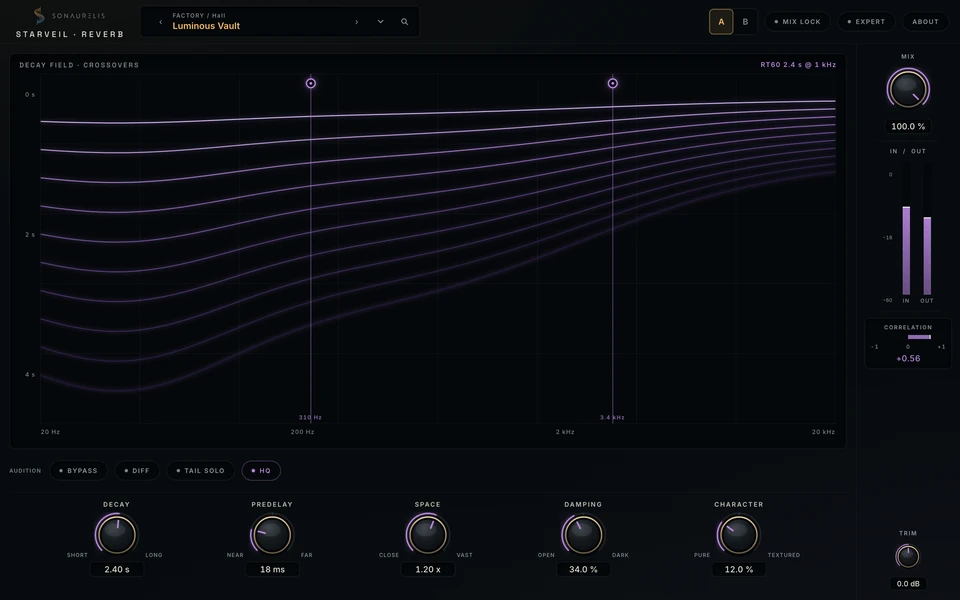
Starveil Reverb — full interface, reference render

Reference render — Sonaurelis Visual Standard v2.0

  • Decay time drawn against frequency, as one continuous field
  • Two crossover handles with live Hz readouts
  • RT60 probe at any frequency you point at
  • Center-zero correlation meter on the rail

The hero display

A field of decay you can hold

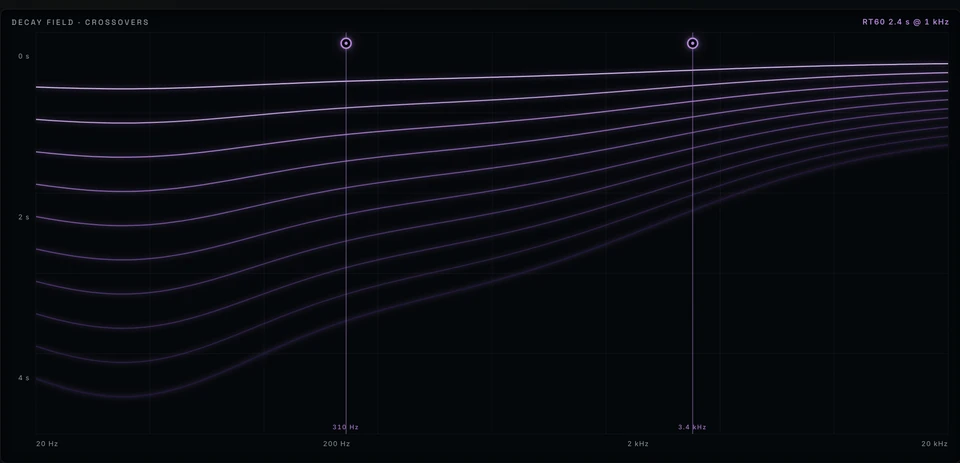
Most reverbs give you a decay number. Starveil draws the decay surface — how long every frequency rings, as a fanned field of violet fibers. Two crossover handles sit inside the field with live Hz readouts: drag them and the lows lengthen or the highs darken exactly where you place the split.

Point anywhere and the probe answers with reverb time at that frequency — RT60 2.40 s @ 1 kHz — measured from the reverb’s own engine, not a lookup table.

Beneath the display, the audition rail keeps judgment one click away:

  • Bypass
  • Diff
  • Tail Solo
  • HQ
Starveil hero display, detail — reference render

Feel-first macros

Eight controls by default

Five feel-first macros shape the space. Exact values live in the chips beneath them, typed entry a double-click away.

Starveil macro band, detail — reference render
  • ShortLong

    Decay

    How long the space rings.

  • NearFar

    Predelay

    How far the room sits behind the dry signal.

  • CloseVast

    Space

    The apparent size of the field around the source.

  • OpenDark

    Damping

    How quickly the top end dies away as the tail rings.

  • PureTextured

    Character

    From clean and transparent to a tail with audible grain.

The expert drawer

Early, tail, spectrum — one key away

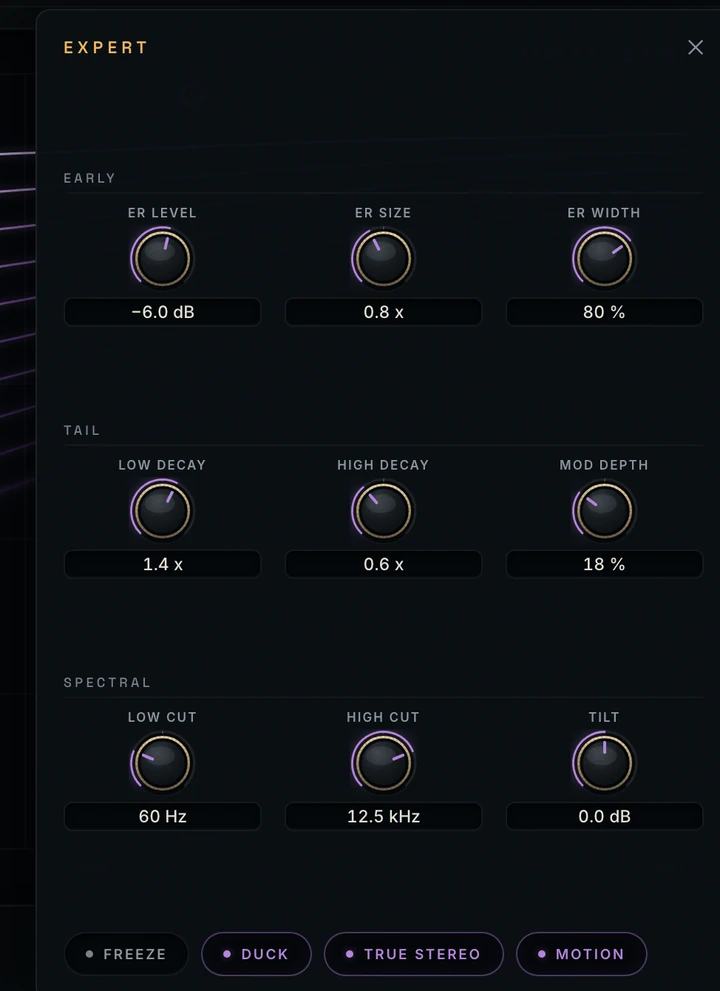
Press E and the full plugin slides out — Early (level · size · width), Tail (low decay · high decay · mod depth), Spectral (low cut · high cut · tilt) — each parameter a knob with its exact value in a chip beneath it. The macro band and meters stay live while it is open.

Hidden, never removed: every parameter stays automatable and preset-addressable whether the drawer is open or closed.

  • Freeze
  • Duck
  • True Stereo
Starveil expert drawer, detail — reference render

Truthful by construction

Watch mono compatibility, don’t guess it

The rail carries a center-zero correlation meter, −1…+1 with a live numeric readout — stereo width you can verify while you widen the tail, not something you check after the bounce.

Suite-wide rule: every moving pixel traces to real telemetry from the plugin’s own DSP. No decorative spectra, no idle animation imitating signal. When nothing plays, the displays hold their calibrated scales at rest — never a synthetic waveform.

Starveil signal rail — Mix, calibrated meters, telemetry; reference render

Specifications

Where it stands today

Status
In development
Platform
macOS
Formats
AU · VST3
In Logic
manufacturer folder “Sonaurelis”
Default controls
8 — five macros · Mix · audition rail
Full parameter set
expert drawer · everything automatable
Window
resizable from 1024 × 640, free corner drag
Privacy
no cloud · no accounts · no telemetry
Launch price
$119 — or the suite of five for $349

Pre-release. Specifications describe the current development target and state nothing that is not true of the design today.

Development, documented

Hear and see the real build when it exists.

Real audio demonstrations and shipping captures will appear only when release-candidate builds exist. Follow the journal for dated build notes—not placeholder proof.