
Adaptive Resonance Control
Toneveil Suppressor
Reduce harshness, ringing, and moving buildup.
Toneveil follows excess energy across the spectrum and reduces it. Use it on harsh vocals, ringing instruments, or to make room for an external sidechain.
In private testing
30-day full trial · no iLok · works offline
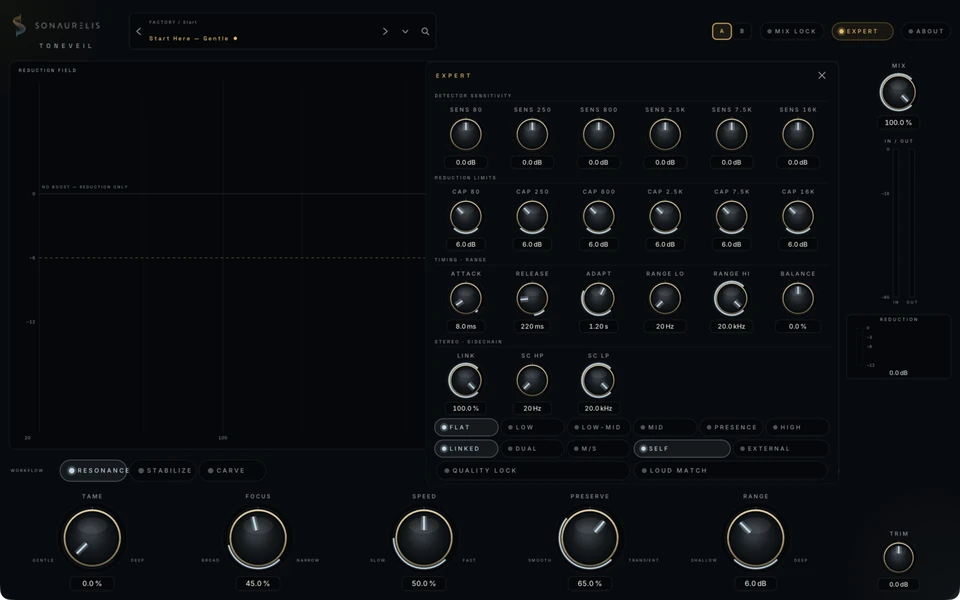

Interface capture · Toneveil Suppressor, Expert controls openStill image · pick a view or enlarge it
The display
See where the cuts happen.
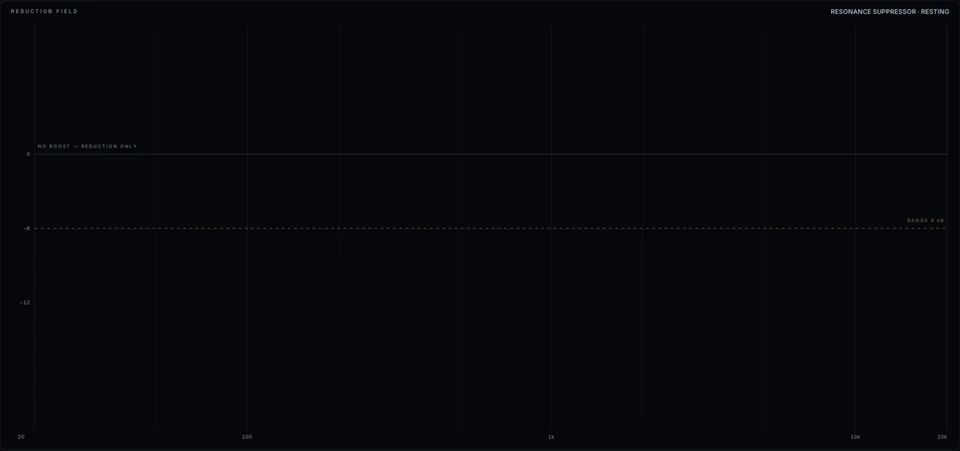
The display runs from 20 Hz to 20 kHz, with zero at the top and attenuation below. The Range line sets the deepest cut the processor can make.
Resonance follows narrow ringing, Stabilize controls broader moving buildup, and Carve makes room for an external sidechain.
- Reduction only, by design: the adaptive engine can’t boost
- Resonance, Stabilize, and sidechain-driven Carve workflows
- Delta plays exactly what is being removed
- Qualified Live and Studio profiles with declared latency
Listen
Examples on the way.
We’re preparing listening examples for Toneveil Suppressor: real sources rendered by the plugin itself, with the dry sound right beside them, like the ones on the Starveil page.
Listen to Starveil’s examplesControls
Tame sets the amount, Focus the width, and Speed the response. Preserve protects transients; Range limits the deepest cut.
TameGentle ↔ Deep
How much of the detected excess is removed. Zero is exact neutral.
FocusBroad ↔ Narrow
From wide, gentle control to individual ringing frequencies.
SpeedSlow ↔ Fast
Moves attack and release together to follow the problem musically.
PreserveSmooth ↔ Transient
Protects onsets so consonants and drum attacks keep their front edge.
RangeShallow ↔ Deep
A hard ceiling on how much any spectral region may be attenuated.
Expert controls
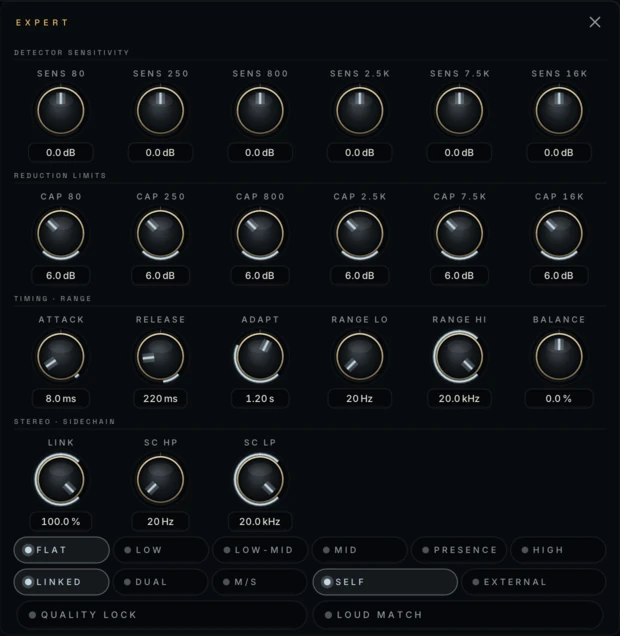
Sensitivity, timing, and sidechain.
- Detectorsix sensitivity anchors · six regional caps
- Timingattack · release · adaptation · frequency range
- Stereo & sidechainlink · M/S · detector input · SC filters
Expert controls stay available for automation and presets.
Metering
Hear what was removed.
A dedicated meter shows reduction from 0 to −12 dB. Delta lets you listen to the difference between the aligned input and processed signal.
Price & trial
Try it first, then keep it.
$39, then $59
$39 until 31 January 2027. One payment, a perpetual license. No subscription, ever.
30-day full trial
Every feature on, with no email, account or card.
After the trial
When the trial ends, the plugins keep playing your sessions and everything you saved still opens. A license unlocks saving new changes.
Specifications
For Apple-Silicon Macs. Use it standalone or in your AUv2 or VST3 host.
Report a problem- Price
- $39 until 31 January 2027, then $59 · perpetual license
- Status
- In private testing · waitlist open
- Trial
- 30 days, every feature on, no email or account
- Platform
- Apple-Silicon Mac · macOS 13 Ventura or later
- Formats
- AUv2 · VST3 · standalone app
- In Logic
- Manufacturer: Sonaurelis
- Latency
- 2,047 samples at default settings, reported to your host
- CPU
- About 2.4% of one Apple M4 core at 48 kHz offline render test; your host’s meter will read differently
- Sample rates
- Tested from 44.1 to 96 kHz
- Session support
- Presets · automation · host recall
- Window
- 1024 × 640 minimum · resizable
- Privacy
- No cloud · no accounts · no telemetry
- Not yet
- AAX (Pro Tools) · Intel Macs · Windows
Why does Toneveil report latency?
Its spectral analysis needs a short window of audio to see a resonance before it reduces it. It reports that delay (2,047 samples at default settings) so your host keeps everything lined up.
Is there a free trial?
Yes. 30 days with every feature on, and no email, account or card. When the trial ends, the plugins keep playing your sessions and everything you saved still opens. A license unlocks saving new changes.
Do I need iLok or an account?
No. Your license is a short code checked on your Mac. No dongle, no activation server, and it works offline for good.
Which hosts does it work in?
Any Mac host that loads AUv2 or VST3 plugins, plus a standalone app. There’s no AAX version yet, so not Pro Tools.
When can I buy it?
The plugins are in private testing now. Join the waitlist below and we’ll email you once, the day they’re out.
Waitlist
Get an email when it’s out.
Toneveil Suppressor is in private testing. Leave your email and we’ll write once, the day it’s ready.
Response returned
You’re on the list.
One email when it launches, and nothing else. Reply ‘unsubscribe’ and you’re off the list.
This page can’t confirm the signup was saved. If you’re unsure, use the basic signup form ↗.